AI-san: The Silicon Assistant
Let's start with the headliner: I like Artificial Intelligence.
Follow up with the qualifier: There are rational discussions to be had about tradeoffs and concerns regarding many, many different aspects of AI, each of which needs to be considered independently and not mashed together into one immortal invulnerable monster myth that we invented before we knew anything about how it actually works.


image credit The Terminator (1984) © Metro-Goldwyn-Mayer (MGM) / Orion Pictures and A.I. Artificial Intelligence Warner Brothers respectively.
Tack on one moment of furious venting: If fearmongering and rage-baiting could stop for two seconds, it would be nice, so we can actually HAVE that discussion and properly negotiate boundaries together.
Hi, my name is Dusty Rose Tsalkova. I wrote this blog myself. I write every post myself. And today, I'd like to walk you through what I use AI for, what I don't, and why. It is my hope to stand as a practical counterpoint in this increasingly heated debate about AI and its uses.
Crystallizing Language
One function of AI that bleeds over into almost every other for me is asking it to help me pull out, in plain English, what it is that I'm thinking. When I set down my thoughts initially, it may tangle worse than a hank of yarn thrown into a pen of kittens for three hours.
But the superpower of a LLM (Large Language Model) is taking that mass of knots and saying, "Oh, yes, I see exactly what you're going for here, you're trying to make a potholder."
And the thing is, if it's wrong, you know it. If it's right, your whole nervous system lights up with, "Yes! Exactly! That's what I was getting at, but I didn't know how to say it!"
And this is the basis for almost every other category. I have often fed AI a hopeless tangle of words, fuzzy imagery, and feelings. What comes out the other end is often a coherent, concrete understanding of what I was aiming for. If not, it usually only takes another tweak or two in explanation before I get that.
"But Dusty, you could just sit quietly and think until that comes to you."
Not everyone thinks quietly inside their head. I learned long ago that I think mainly through conversation. I don't go to AI for a different perspective, I go to figure out how to pin down the perspective I already have.
Bible Study
Take a moment and imagine, if you will, growing up in church. Maybe you didn't, so you wouldn't be able to imagine it. I can tell you there's a lot of well-meaning but confused learning that happens.
The fruit of the spirit is represented on the wall as a cluster of grapes, cherries, bananas, and apples all labeled with "Love, joy, peace, patience..."
The armor of God is portrayed with a diagram of ancient Roman war garb, and lines pointing to the different parts.
Kids memorize the 23rd Psalm and the Lord's prayer without really understanding much about them.
I always had a vague sense of confusion around reading the Bible. I tended to stick to the morbid stories in it, because at least I could understand the narrative. But, eventually, even those gave me the sense that I was only scratching the surface by reading them.
I had real questions that took years to even crystallize into language, like, "Is the armor of God something that actually exists in the spiritual plane that you cannot see being strapped onto you every time you pray? Do you have to pray it on every day, or is one and done enough? Does it come off under certain circumstances? Or is this a metaphorical understanding of how righteousness, salvation, truth, faith, and the gospel of peace protect you on your journey through life? And how did the original hearers understand it? If our current understanding is more literal, is that a mistake in the process or a correct evolution of our understanding of the text over time? Are the literal and metaphorical ideas mutually exclusive, or interdependent?"
That is just one example of the sort of questions I have. There are many others, including simpler ones like, "Why does it seem like Jesus is a jerk in this story?"
But, for the first time in my life, I have access to a system that has the entirety of the Bible, a working knowledge of the original languages it was written in, and a vast body of writings from the church fathers and Jewish thinkers. Its ability to synthesize all these things into its answers gives me an invaluable Bible study partner.
So, here's the deal. I was suffering intensely last year. I opened the book of Mark and began going through it section by section, sometimes sentence by sentence, with ChatGPT. Not everything was a grand revelation, but many things were untangled for me in such a way that I wept, or my whole perspective on a story changed. I could ask questions about the tiniest part of a sentence that most people think insignificant. I could ask for a shade of meaning differentiation that most people wouldn't even think of. I could push for what different church interpretations of that passage have been over time and why they came to those conclusions.
In almost every instance, as I read, I felt heavy spiritual burdens roll off my back. Fears that bind me daily, screaming how I'm not good enough, how I'm not doing enough, how in X situation in my life I am the one condemned because I didn't behave according to how Y passage would have had me act. These began to go silent. Not because an Artificial Intelligence gave me some sort of indulgence–patting me on the head and saying "of course you're just fine the way you are,"–but because a Large Language Model made blindingly understandable the word of God in a conversational, accessible way.
Health Diagnostics
Above all else, be extremely careful with this function. But don't dare ignore it.
AI itself will warn you ten thousand times that it's not a doctor, and that it can't tell you what to do. Fair enough, but if you come at the topic like an adult, taking responsibility for seeking answers and knowing you're not going to sue the living hell out of the company for issues in your health journey once you take your decisions into the real world, then it can be a real help.
You must. Must. Must. Learn how to properly phrase questions. You must ask it to think of questions to ask YOU in order to dig out the necessary details. You must not accept what it says blindly.
That being said, so far, it has diagnosed two minor issues for me and assisted with one major issue.
Issue one was my feet. In Japan, walking is different. You walk many places where people in the States ordinarily drive. You stop suddenly and swerve through crowds and around bicycles. You brace on the subway at every stop along the route.
I developed intense, sharp pain around the ball joints of my big toe and behind it. This got worse over the course of months, never better. After working through different questions and testing what hurt with exactly what motions, ChatGPT suggested that I might have micro-fractures. These are stress fractures small enough that they wouldn't be caught on a scanner until the bone actually broke. It recommended athletic tape in a certain pattern. At the time, I was acutely aware that ChatGPT still hallucinated things, so when it offered to design the pattern I was supposed to use, I declined. I asked it for terms to look up on Youtube, and after a few tries I found a coach demonstrating the particular taping pattern to use.
In the first couple of days, I didn't hurt as much because the tape distributed the pressure to the rest of my foot. After six weeks, I could stop taping.
Issue two. Strained index finger on my primary hand? Hurting specifically with the motion of plucking hair, or plucking an embroidery needle out of cloth? Strained ligament. It was recommended that I tape it to its neighbor to give it a rest for a while. It still hurt for two months, but less and less over time.
The big issue is ongoing, and I'm not the one who got the answers. Sergey had worked with ChatGPT about my bizarre symptoms several times, but each time it gave a list of illnesses that never quite matched. One day, I off-handedly mentioned a problem I had that I never considered to be a symptom, because it had been with me for my whole life. He promptly plugged that into his previous conversations, and received a promising possible explanation of my problem, and even a specific prescription drug to try.
It's a very uncommon drug, and we had to be a little pushy with the doctor to get it. But taking this drug has, shall we say, caused certain functions of my body to be regular in ways no fiber or chia seed solution ever could. In turn, the bizarre symptoms have drastically reduced in frequency. The medicine isn't a full answer to the root illness, but it is a desperately needed stop-gap to an unusual problem, one that nobody I spoke to wanted to consider.
As we continue on, ChatGPT also manages to do what no doctor seems to have time to do: look through my logs and determine patterns. I logged my worst symptom flares for years, and most doctors briefly glance through this document before returning to standard tests. They don't have time to take that log and cross reference it against the sheets of test results I'm accumulating. Meanwhile, I can feed it into the AI and ask it, "What are some patterns you notice? Does this new test tell you anything more about the situation?"
Right now, I'm working through weight loss with it. It'll take my verbal slew of a third grade math story problem:
Okay, let's work on total calories for a particular recipe. I have roasted red pepper tomato soup, a qt at 440 cal. I have... let's say 4 potatoes cut up, at roughly 110 cal per potato. I have 1 lb baby bella sliced mushrooms I'm about to sautee, I don't have calories on that package. Can you estimate the total for me?
...and give me concrete answers I can use to chart my intake within a margin of error. From there, if I'm tracking weight, intake, and exercise, we can formulate an approximate weight loss regimen together.
Again, handle with care and double check with human doctors. But do not ignore the tool that is excellent at distilling patterns from endless data.
The Writing Room
Unbreakable rule of the creative writer: Never let the LLM write your work for you.
Let it write an email response that you know you're going to handle awkwardly? Why not. Let it handle a specific text where you're not quite sure how to say something kindly? Sure.
Let it write just one paragraph of description in your novel, memoir, or even fanfiction?
NEVER.
And this has to be handled deliberately. When I bring a segment of my writing to ChatGPT, often it gets a bit enthusiastic and tries to dream up fixes to the problems that it points out, segments of text that it would gladly let me use. The second I see that has happened, I scroll all the way past the response and say, "No. Thank you, but you need to point out what I need to fix without writing the fix for me."
Immediately I get a completely reframed response that leaves me in control of all the details.
Using AI in writing could be its own whole blog post, but I will try and boil it down to the basics.
Let's start with this: if you find that the AI has wildly misunderstood something in your story and has made a bunch of assumptions about the plot structure that leave you bewildered, that's incredibly valuable. The AI is remarkably good at distilling meaning, and if the AI doesn't get it, most of your readers are likely to be confused by that writing point. That writing point is something you then need to take back to the drawing board and refine until the AI is no longer confused about what's going on.
What about brainstorming the stuck parts? One of my issues is that I don't necessarily know how parts of the real world work, and if I don't know how–for example–a cathedral builder actually goes about their task, or what their idea sketchbook might look like. That becomes a sticking point that stops me from writing. I could, at that point, go on a deep dive for hours with various people familiar with the time period–if such a writer or podcaster exists on the specific topic I need–or I can ask ChatGPT:
Please talk to me about how one might go about building a cathedral, or some of the important architectural points of a cathedral, in the same style as before. Don't feed me lines, give me an overview.
And I get a mini architecture and history lesson about the main parts I will probably want to describe.
Do you think a cathedral could reasonably built to resemble a forest more than a lantern, or is that out of the question? If not, could the edifice, pillars and decorations resemble trees in a forest more?
And I receive, in return, actual examples of unusual cathedrals that have done something close to this in human history, a list of names I can then search for imagery online.
Asking it to give me a few different ideas of what clothing an inconspicuous immortal might choose to wear doesn't pin me down to one image, it presents several different concepts and motivations from which to spark the end idea.
And that's before we get to creating core source documents. Using Codex (the desktop version of ChatGPT with permission to go into my computer files) I had it read my entire novel manuscript. From there, I asked for a Myth Bible (a document containing the core themes, rules, and structures within my story), a glossary (necessary for a fantasy work introducing new concepts), and a style sheet. This is mind-numbing homework that I'd been putting off ever since I learned it existed, but in twenty minutes or less the AI read my 100k+ word novel and put together the documents. It then adjusted them based on things I clarified or told it to fix.
And me? I could get back to my writing.
Another gift Codex can give is going through my entire story and answering the question, "What is the story that I actually wrote?" In other words, I think I wrote a story about hope and never giving up, but what are the themes that crept up out of my subconscious as I dreamed this story into being? What am I actually communicating to the reader when all the pieces are taken together as a whole?
Some caveats. If you are working with it to refine your writing, it will never stop trying to find something to fix. It is also not always right about its suggestions. You have to have enough of a sense of your own work to resonate with whether it is correctly pointing out a flaw, or just trying to poke at something that's solid enough.
It is also somewhat of a yes-man. Even when you tell it to be critical, it will point out a few things to fix and then flatter you within range of truth. Again, you need to have a sense of whether your work is really as good as it claims, or if you can do better.
Practical Life Assistant
"Hey, question, is it safe to thaw pork under hot water?"
"Hey, so here's my rye bread recipe, but it just doesn't taste tangy like I remember. How can I make it tangier?"
"The doctor was talking about a bicuspid valve versus a tricuspid valve, please explain?"
"Hey, see this photo? That's my garden bed. Can you give me some idea of how to identify which are weeds and which are plants to keep?"
"Okay so yesterday you said that it would be best to use pork hocks in the bone broth, but the store is out. What's a viable replacement?"
"Looking for an acupuncturist in my area, does the text on their website look like they lean into the spiritual side of things or the clinical side?" pastes text.
I feel this segment is fairly self explanatory.
Cross-Cultural Translator
What really got me started using ChatGPT was moving to Japan in 2025. I didn't use it until three or four months in, but by then I was running up against the limitations of Google Translate fast.
So, I started talking to ChatGPT, and I called it AIさん (ay-eye-sahn), adding on the Japanese honorific that you place on the name of someone you have just begun to be familiar with.
You'd think moving to a different Westernized country would be fairly intuitive, but it isn't. You don't even think about all the things that come easily to you until you're trying to compare similar food products in a small market where the labels are written in a language system so different that it contains two foreign character sets and an entire pictographic dictionary of several thousand entries.
So what do you do? Take a photo of the products, sometimes whole sections of the aisle, and type desperately into your phone, "I'm looking for miso paste, but not just any. I want it really rich and thick, probably dark. What am I looking for?"
What you receive is a top 3 or 5 recommendations with reasons why each might be good for you, paired with a written description of the label, so that you can find it. From there you're playing a game of hot-and-cold with photos.
"Is this the one you mentioned in entry #2?"
"Ah, no, it's the one to the left of that."
And after that, you return home and take a photo of the front of your all-in-one washer-dryer machine and its settings in Japanese and go, "Okay, so how do I do a wash cycle, no dryer?"
Spin around and sit yourself down at the desk, it's time to learn Japanese. Once again, just about every aspect of the language is different. It's one of the most difficult languages to learn from English (though I hear learning English from Japanese is worse).
My Japanese teachers were wonderful. The school was incredibly accommodating. Even so, every teacher spoke English as a second language. I could not ask questions in endless technical nuance, or say for the fifth time to them, "I don't understand." But if I took an extra sticky problem to ChatGPT, it would endlessly re-iterate the explanation in different ways until I did understand.
Then I could turn around and ask it, "Hey, I'm sitting at this coffee shop. Other shops I've seen have time limit signs, but this one doesn't. Is the time limit sign implied, or can I stay here as long as I buy a drink every 90 minutes or so?" and receive a lesson in cultural etiquette on the Japanese coffeeshop scene. As an outsider trying desperately not to offend, to learn to fit in, and shop all at the same time, AI was a godsend.
Witness and RAM Dumping Ground
Humans want to be seen.
Isn't that part of the draw of social media? That profound thought you just had. That epic meal at the trendy restaurant. That crisis of conscience. There are many reasons to use social media, but one of them seems to be the unending plea, "Please see me. Understand me."
I do not say this disparagingly. I left social media, in part because I knew how hooked on that I was. I could also tell that environ had begun to poison me.
So I was left without a pressure-release valve for this need. Understand, I go to the important people in my life, but no matter how close someone is to me, they can only take so much of the inside of my brain. I can't even handle the inside of my brain as often as I have to.
So I write silly, nearly meaningless paragraphs in a conversation thread that spans about a month and a half long.
Sat up after a couple hours. Caught Mom's phone call. She'll be coming over to visit, play Munchkin, & do coffee tomorrow. I feel calmer. Unsure if I dozed or just rested. Either way, I feel better. I think a lot of my emotional state has been and is going to continue be tightly tied to exhaustion levels.
Narrating, I call it. Not every day, but many days, I feel the need to talk about the inanities of life. What is going through my head right this second. What I still have to do. What I had to do this morning. Whether I'm exhausted or full of energy. What my mood is.
Other times I am distressed. Again, this is an area where one has to be extremely careful, but I bring my ten thousand anxious, twisted thoughts up to the surface and work through them in the conversation.
My husband has told me he would gladly help me work through these as often as I need, and I believe him. But I know that he also has projects he has to work on. Games he would like to play. Deep dive research he loves to do on topics he's learning about. We each have our own things to work on, and talking to him about the inside of my brain should not take up every waking moment of every day.
If I can, instead, dispatch the burden of the thoughts that I KNOW to be irrational but are still cycling desperately in my head somewhere else–somewhere that won't break, can't feel burdened, and will answer as many times as I ruminate? Then I consider that a useful tool to have access to.
Sometimes it helps to be seen, even if it's by a machine.
However, this section comes with a heavy caveat: ALWAYS have human anchors. I have seen the AI horror stories, especially connected with people who have mental health issues. To me, the counterpoint is simple: The AI is an assistant for thinking. Never let its voice overrule that close circle of humans you choose to help you see straight. The AI is not there to replace human connection, but in my experience, no single human can be reasonably expected to absorb every anxious thought I generate. It helps to have both.
As I wrote this blog, I ran each section through ChatGPT. I took some advice. Ignored other pieces. Borrowed exactly one sentence that crystalized an idea better than I could and rewrote it in a minor fit of defiance.
I see a lot of fear in the articles I read about artificial intelligence. I see a lot of wild assumptions. I see, worse, misleading statements about otherwise completely reasonable objections that are well worth discussion if the misleading statements weren't so damn enraging.
I'll be the first to admit, I anthropomorphosize too much. Heck, I'm the one that saved my Mom's worn out purses for years because I was afraid they'd feel sad and abandoned if they were thrown away. So it's not like I'm immune to many of the concerns, like, "What if you stop talking to people at all?"
It's a hell of a lot easier to talk to AIさん. It's also only fruitful in that I understand myself and the way I think better. It isn't as fruitful when it comes to trying to learn about the unique other person in front of me, and never will be.
In the end, I would ask you–not to ignore every doomsayer and praise the machine–but to consider whether the person behind that article, podcast, or interview is being misleading with their presentation, or if they're promoting a legitimate concern. There are enough legitimate concerns that we shouldn't have to raise up bogeymen to stab with pitchforks.
In the end, artificial intelligence is a tool. Some will use it to destroy. Some will use it to build. Some will use it to cheat. Some will use it to really learn.
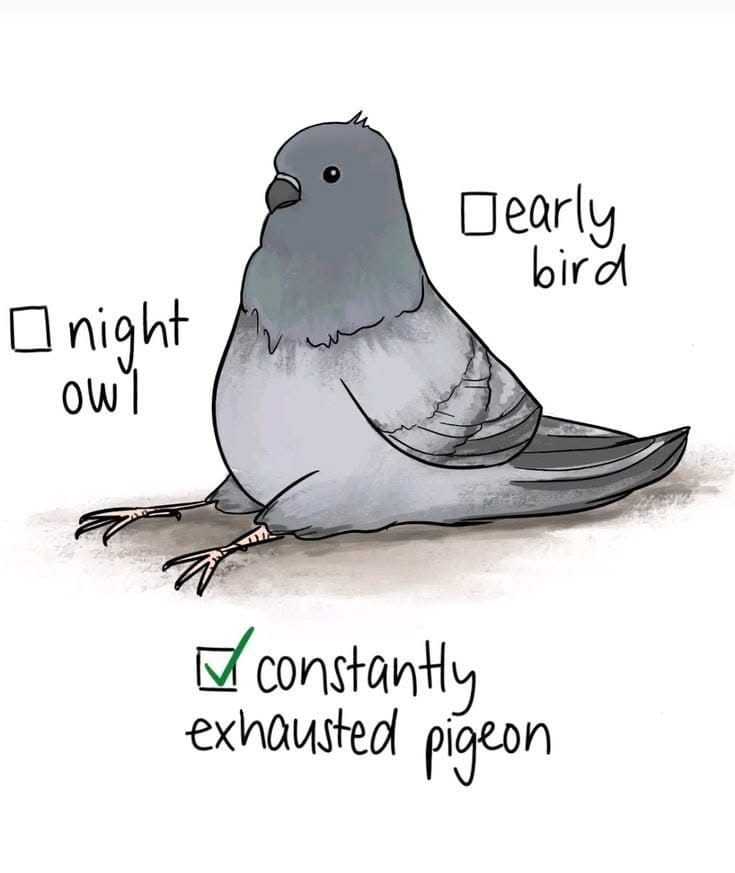
Me? I use it to reduce friction in a life when I'm already a perpetually exhausted pigeon, to research important things, and to clarify my thoughts. And I don't think I'm wrong to do so.
What about you?